Saturday, June 12, 2010

Field Work Journal (Part 3)

6/7
Working in reverse, I started to examine how inching caterpillars may revert to crawling gait. Behaviorally it's quite feasible and we've observed some tiny step crawling when inchworms adjust their bodies on the foliage. My discovery of the day was that by constraining the uplifting body bend, I can actually induce crawling in many caterpillars that inch as their default gait. What I did was a very simple behavioral experiment: take a sheet of heavy duty plastic bag and lay it on top of a inching caterpillar on a flat surface. The result was quite stunning: the weight of the plastic prevent body upward bulking, so the inchworms start the stereotypical anterior-grade crawling. The very second plastic sheet constraint is gone (when I remove the plastic sheet or when they simply crawl out from under the sheet) they start inching again. This transition can happen at any phase of a gait cycle and so reversible that I can't imaging any other gait transition mechanism other than a biomechanical one. The implication is quite mind-bogging: inching gaits came naturally when mid-abdominal segments are not locked down to the substrate.6/8
I went back to the memorial behind the casona today for the sunset. Actually I went with my friend Ian. The casona is a big historic farm house that has been converted to a little museum to document the development of ACG. The memorial was built for many worriers and political leaders who defended Costa Rica against an ambitious Nicaragua war-lord in 80's. This memorial is about two stories high at the top of a hill, overlooking the entire Santa Rosa sector and the two main volcanoes on the other side of the intercontinental highway. We walked up there briskly right after dinner and caught glimpse of sunset. Before it became pitch-dark, I looked around and wonder where the scorpion I met earlier went, and whether it also lingered around at sunset.
6/9
My Costa Rica stay is drawing to an end, but I feel that everything has just become part of my life... three meals of rice and beans everyday, new trails everywhere, mosquito swarms at certain spots, incomprehensible language that sounds very familiar, WiFi domain guided by the trees, checking e-mail late at night in pitch-dark with some frogs as companies. The list goes on and on, making my experience quite unforgettable.
Today I decided to stop looking for caterpillars, otherwise I can't really wrap up the study. I went back to the caterpillar barn to examine all the caterpillars I've been working with and start to let them lose. If there is a video that is so amusing and that I can release freely, it is this video that I captured today of two noctuidae inching along a jar cover. Why is it funny? Well, I love the way they negotiate with each other. This circular walk lasted for about 6min until I got tired of filming. Apparently, you don't need very fancy enclosure to keep inching caterpillars. They would happily stay on a nice upright track even if it has a periodic boundary -- never ending. Isn't that what we call "inertia"?

Field Work Journal (Part 2)

6/4
I started another day with fried rice and beans plus scramble eggs and cheese. Just when I got to my second coffee around 7:30am the bus brought in all the park rangers in for breakfast. People streamed into the Comidor with greetings and jokes. I watched them eat and talk and set out to work with a mouthful of Costa Rican rice coffee aroma. Somewhere in my heart, I envied such life: so simple, so natural and communal.
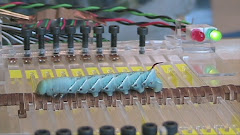
It’s time to organize data and find out what and what else can I get out of this trip. I started up with three aspects: Biometry, Kinematics, and Behavior. The biometry project was targeted to compare the biometry proportions of different caterpillar species as well as tracking down the ontogenetic scaling of some species. The only way to perform measurements on soft-bodied animal is to use photography. Unfortunately, caterpillars are wild animals after all. There is no easy way to get them to sit still in a specific posture while I photograph. Weighing them is also impractical because many of them do not relinquish their substrate (often their food as well). Brute force can injure caterpillars and decrease their survival rate dramatically, making ontogenetic tracking impossible. However, the general biometry can be still obtained from the video frames I collect in the kinematics project. One of the measurements I was looking for is the aspect ratio of the cylindrical body. Compare the two caterpillars before and after this paragraph to see what I mean.

6/5
In a forest full of activities, it is very difficult to stay put for more than a day. Although I haven’t finished the image organization on my two EEE PCs, I decide to head out to the field anyways. As the sun journeyed pass 10am, the wet “dry forest” turned into a steamer. I could smell many things around me, from fresh leaves to fermentation in the rotten woods. The strongest of all was a pungent smell that reminded me of steamed peanuts. I never figured out what that was, but it definitely imprinted in my memory of Santa Rosa. Anyways, the most memorable discovery from today’s field work was a leaf craftily “eaten” into a beautiful symmetric pattern. I couldn’t help but respect the "minds" of these wild caterpillars.

Over time, I found myself very tuned in to looking for caterpillars. I could distinguish leaves damaged by caterpillars from those eaten by ants or beetles. I was able to spot the caterpillar feces and trace the source to a plant, and I became pretty picky about what caterpillar I get. One of the tasks for today’s field work was to collect some cydista plants for my Manduca lanuginose. This was the only Manduca I found so far so I really should keep them alive. Just as I was full with plastic bags of caterpillar and plant harvest, something lighted up my eyes. It was a huge Manduca sexta gorging up a Solanum hayesii. I was very excited to see such a familiar body even though my memory of Manduca has been this obstinate stupid animal in the lab. For some reason, the wild type looked much brighter in color. It’s got a puffy body with clear healthy white lateral strips. Maybe the organic food really made a difference.

6/6
The English speaking researchers tend to cluster in one table at dinner, although many of them speak perfect Spanish. I have been meaning to learn to speak a few words, but the data organization work every night really crushed my ambition. Over some rice and beans with pork stomach, we talked about what we encountered during the day and frustration with the animals. Indeed, field work is a very different mode of research. We are studying the organisms in the great nature which is beyond our power to control. We cannot force any activities or interactions. We must let them come to us. Patience is the key and letting things be is the attitude.

Due to my field work during the day, I started to shift my caterpillar photography work to after dinner. Tonight, I found a keystone to solving the gait transition mystery in caterpillars. So far I’ve found caterpillars that inch with reduced prolegs and caterpillar that crawl with full prolegs. This caterpillar I picked up today inches with full prolegs, displaying how exactly a inching gait can be derived from a crawling pattern. This spotted caterpillar had a full set of functional prolegs from abdominent 3rd. However, when it picked up speed to run away from me, it lifted very large proportion of its body and actually cut under itself to gain the maximum step length. The whole gait pattern resembled a very conservative inching which can be shifted into a crawl at any moment in a cycle.

Thursday, June 3, 2010

Field Work Journal (Part 1)

Part 1 --- 6/1~3

6/1
I was so busy figuring out experimental protocols and data analysis during the first week of my stay. Every night I barely had energy to brush my teeth, not to mentioned writing in my journal book. My advisor left yesterday so I’m literally on my own now. But I think I am in good hands. The dormitory house keeper Lily helped me with my laundry on Sunday even though I didn’t have any soap. When I came back in 40min, she was already folding my clean dried clothes in the laundry room. The cook Aida came up with some food for me tonight when I worked overtime and forgot about the dinner time. Somehow I think they could empathize this poor young Asian kid who doesn’t even know how to say “por favor”. Of course, Dan and Winnie continued to bring me interesting caterpillars when they encounter them. What more could I wish for in the care of these people.
All the inching caterpillars I worked with so far tend to be very active. Some of them moved with impressive speed (up to ~4cm/s). In addition, they can also perform various acrobatic moves especially in the situation of disturbance. This Anomis I picked up today demonstrated one of the most memorable moves in front of my camera. It simply “disappeared” when I poked it on the rear back. 300fps high speed video showed exactly what it did. The caterpillar first span some silk around the thoracic legs, then it flip its whole body sideway with extremely high speed. The prolegs release was nicely coordinated to let go of the momentum it built up. The result was a ballistic lateral jump. The caterpillar landed on another leaf below the substrate I provided. It then used the silk line to climb back to the exact same spot where it jumped off. I simply couldn’t say a word but marvel such innate skill.

6/2
I took today off for a hike with my new friends, mainly to explore the conservation area and also to get some exercises. The focus of field collection was never about walking, and I found myself so out of shape. Nevertheless, I carried my big CASIO EXLIM camera in case my SONY Cybershot can’t do some animals justice. Field exploration is very much part of the field work. You never know what you would find by wondering about without a particular search criterion in mind. We started out right after breakfast at 7:30am and headed straight down to the valley. It was a pretty damaging road for most cars, but an easy one for hikers.
I met more butterflies than caterpillars on my way down to the coast line. They all cluster under the sun sucking liquid on the mud or some rocks. Wing flaps by wing flaps just like having group meetings. The blazing sun started to steam up the water from yesterday’s rain. Each water puddle contained thousands of tadpoles and supported tens of water surface insects. I found another beetle larva moving upside down by peristaltic on the rocky ground. I wonder why they still keep their thoracic legs if they don’t even use it for locomotion. At the bottom of the valley we crossed two rivers. We met a gang of monkeys after we waded across the second one. My friend was somewhat aggressive on photo shooting, that the monkeys decided to protest. Several of them started breaking branches to drop on top of us, and many more gather over. We left soon after these demonstrations. Sometimes, communication can be so effective. We were caught in the pouring rain when we reached the beach. It didn’t bother us much since we were all soaking wet in sweat anyways. Sweat, rain, and Pacific Ocean all mixed together as we headed back to the research station.

6/3
Today I had to move out of my room to stay with other researchers. It was a bit of a hassle, but I don't mind joining the party. Having a room with four double bunkers for myself is too luxurious out in the forest. It was always an adventure to interact with the ACG staffs, because I pretty much don't speak Spanish and many of them don't speak English. In any case, we all managed to came to the same conclusion on our subject whatever it was. Still, I wish I spoke Spanish. I’m missing so much.
My caterpillars in the barn are doing pretty well now. But I need to finish up filming these caterpillars before I can get more. I can never predict when I will lose them to stress, parasite, or pupation. The inchworm Sphacelodes I picked up before breakfast was the largest geo I’ve even seen. It’s about 3.5 cm long and weighed 0.146g. However, it had every bit of athleticism of Geometridae. Most geo’s preferred to inch on top of the branches if possible, but this one had much stronger preference. When I turned it upside down on my dowel, it started to have trouble pulling the body in. After a few steps it just spiraled around to the top of the dowel again. Well, counter-levering a hydrostatic body up to 3.5cm long does become pretty difficult with only ~0.5cm leverage.

Sunday, May 30, 2010

Costa Rica Field Work

It's been over a month since I last updated my blog. I truly apologize for those who follow my blog. But honestly, this is my first chance since mid April to catch a breath and log in to my blog. In any case, I'm currently in Costa Rica for a field work, tracking down an amazing collection of caterpillars in the tropics. Pictures and field work journals will follow. Stay tuned in the next 10 days.

The week before I set off to Costa Rica, I questioned myself once about this trip. What exactly do I expect to get out of the forests? Do I really need so many projects for my Ph.D? With two manuscripts pending and an international conference travel coming up, setting up my first field work at a distant foreign place was the last thing I needed. However, as my adviser and I arrived at the Area de Conservación Guanacaste, Costa Rica, my doubt dissolved instantly. It is totally worth the sleepless April and May. For the following week, I will be posting my field work journal. They all consist of two paragraphs. The first one contains something about my field experience. In the second paragraph you will find some portraits of what I saw in the field and animal interactions. For my research, I will focus on locomotion in different caterpillars and some associated behaviors.

Tuesday, April 20, 2010

For those who track 3D

Folks in the field of animal locomotion would know how kinematics data are usually obtained. But allow me to summary the general procedure in a few sentences. To track anything in 3D, at least two camera views have to be available at all time. After space calibration, one can calculate the 3D configurations of the objects in the analysis software of his/her choice. Ideally, video tracking can use any inherent features of the subject. However, to facilitate automatic tracking, high contrast makers are often attached to the subject. Infrared markers offer a way to highlight the features of interest without compromising the lighting for the normal video acquisition. After I created two families of soft-bodied robots, I was challenged by the need of quantitative data. These kinematics data are critical for any mechanical analysis on the robot locomotion.I set up our VICON 3D system to track my robot kinematics at Tufts Advanced Technology Laboratory. VICON is a company that makes 3D tracking systems for research in locomotion and animation industry. It employed several near infrared high speed cameras which would detect the IR signals coming off the retro-reflective markers attached to the subject. Unfortunately, retro-reflective marking is really not the way to track small animals such as insects or robots of the same scale. After going through many types of IR florescent chemicals, I finally decided to go with semi-conductor IR emitters (or infrared LEDs).
This works out really great for my application because I do not need to worry about IR light flooding or bad camera focus. These surface mount IR emitters produce point-source lighting smaller than 1mm. The IR cameras pick them up like many distant stars. In fact, a little out of focus actually increase the pixel numbers from which the centroid positions are derived.
Data are coming alright, but my data crunching techniques are still too slow for the rate by which these high speed cameras acquire data. I better work on that!

Friday, April 2, 2010

Gait transition and embeded AI

A couple of years back, I was deeply impressed by probably the most well-known bio-inspired robot which demonstrated the effects of central pattern generator on gait transitions. This is the EPFL salamander robot with coupled non-linear oscillators. In this research amphibious robot, smooth gait transitions were accomplished by tuning the gain of oscillators coupling.

As I started working on soft-bodied robots, I discovered that many non-linear characteristics of the soft materials and actuators can be exploited to engineer behaviors. So I took a completely different approach to robot control. Instead of programming complex behaviors on a micro-processors, I "tuned" the body and actuators so they create desirable behaviors when I switch on a behavioral circuit. Amazingly, when the motor variations and body properties reach a certain domain, the robot was able to achieve gait transitions with a simple scaling of motor-pattern. This is a very intriguing demonstration because it provokes a rather radical inquiry: how much logic/intelligence can we embed in a piece of material? To what extent can we use morphing morphologies to perform computation (or thinking if you will)?

Thursday, April 1, 2010

Multi-threading...

A lot has happened in the past few weeks. Besides my secondary injury during my recovery of my bone fracture, everything else seems to progress in a positive direction.

First of all, my paper on caterpillar ground reaction forces was finally printed. It's been really over-due for a year now. Most data were collected by Christmas 2008, and I actually presented the major finding at the SICB 2009 January. I felt pretty bad about this delay but the robotics project last year really took my life from March through October. To summarize the findings in a few sentences: large caterpillars such as Manduca sexta load their bodies in constant tension when they are attached to a substrate. Locomotion was achieved by progressing the body tension/deformation forward. Biomechanically speaking, these critters use the substrate as their external skeletons. We call this strategy: environmental skeleton. For more details on this radical view of soft-bodied animal body control, check out the April 1st issue of the Journal of Experimental Biology. If you would like a PDF copy of my paper, simply e-mail me at huai-ti.lin@tufts.edu and I will gladly send you one.

Besides my old new paper, I've been planning a field trip to Costa Rica for this May and June. Last spring at the SICB conference, I bought a few books about caterpillars. Among them, I was really impressed by a couple of books regarding tropical caterpillar diversity. So I contacted the authors Dr. Daniel Janzen et al and was struck by the idea of visiting the home of caterpillars in the wild. Lab animals are always somewhat unnatural. This idea was incubated in the back of my mind for many months until I finally formulated it into a more concrete field study project. My mentor Dr. Barry Trimmer was very supportive of the idea and quickly decided to make it happen. In any case, we have now arranged a 17 days field work at a conservation in Santa Rosa, collaborating with Dr. Janzen's team from UPenn.

Finally, to continue the imaging theme from last time, let me share a few images from our histology for Manduca caterpillars. Working together with my great undergraduate lab-mate Dan, we've been able to produce very clean cross-sections of caterpillar abdomens.Through some imaging techniques, we can enhance the cuticular folds.Or we can also highlight the muscles! So awesome... the biology I mean (but we're not bad either)