Wednesday, September 15, 2010

Mechanics of a ballistic roll - Part 2

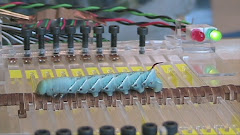
GoQBot is a soft-bodied robot designed to simulate the ballistic rolling escape behavior in caterpillars. The robot mimics the scale, timing and morphing of the behavior while allowing us to explore the control parameters and perform dynamics tracking. Please refer to earlier posts for more background information.
Kinematics tracking can be very tricky especially with high speed erratic movements. In order to compute the angular momentum of GoQBot, we must know the mass distribution of the robot as it deforms quickly within the 0.2 second window. One way to do it is to break down the body into many segments and track each segment individually. However, that requires installing more than twenty 1-mm size IR emitters on a small soft body no longer than 12cm. The soldering would be simply a torture, not to mention the wiring. Luckily, there is an alternative: kinematics-based model extrapolation.The idea is to constrain a virtual model of the GoQBot using the five IR-marked coordinates as the reference. By applying some deformation characteristics on the model, I can easily extrapolate the positions of every bit of the robot. This is exactly what I have done.

Monday, September 6, 2010

Sharing research tools and links

Hi there,

A new section has been added to my blog called "Huai-Ti's research tools". There you would find some useful links from general referencing to good online stores. There are also some good deals such as a free SEM imaging program (but the image will be public). In addition, you may find some useful software for making presentations or publications. For example, there is a Screen Capture Software that streamlines the print-screen function in most computers. Anyways, stuffs like this could be useful when you need it. I will populate this list gradually.

Over the past four years of my R&D, I have designed over 12 instruments, written more than 5 systems of feedback control programs, placed more than 85 orders for supplies and parts. I guess the number of projects and pet projects in experimental science directly correlates to the spending and instrumentation. Also, people in my research team tend to leave purchasing jobs to me since I've been really good at communicating with vendors and company associates to get the right parts for laboratory research. But I have to say such job is really stressful, although all the spending came from various research grants and not from my pocket.

Friday, September 3, 2010

Mechanics of a ballistic roll - Part 1

First off... I would like to remind you of the behavior that I'm studying. See the ballistic rolls and flips in some leaf roller caterpillars, and check out my biomimetic GoQBot's performance.

To study the the dynamics of such impressive behavior, the robot has been a great tool to test hypotheses and facilitated the collection of mechanical and control data. Back in April this year, I successfully collected the kinematics of GoQBot using my own adaptation of the VICON motion capture system. However, the kinematics data alone only tells half of the story. We could compute the angular momentum as well as the linear momentum from pure motion tracking. However, there is no data on the mechanical power output and loading condition. To extend the analysis, I took one of the force beams I used for caterpillar ground reaction forces measurement and implemented it for robot GRF collection. In fact, VICON system has built-in capabilities to take in force-plate measurements and any other analog signals.With some modification and instrumentation, I obtained GRF in two directions from the head anchor and simultaneous recording of the actuator current draw during the high speed kinematics recording. Here are some very preliminary data.I'm currently processing the data to calculate the center of mass and the development of angular momentum. More results are coming!!

Wednesday, August 18, 2010

Stop crawling... pace up!!

My Ph.D defense is coming up in December. I better hurry and pace up. When I was 7, I thought about a great deal of things about academic research and becoming a Ph.D. But I always thought of them in future tense. Time is truly incredible.

In any case, I just sent out another manuscript to Journal of Experimental Biology about my studies on the hydrostatic skeleton on caterpillars... three chapters of my thesis done... now onto the fourth one: soft-bodied robots.

Well, thesis writing requires a lot of integration and I've been organizing all my research files in my multiple hard drives as well as lab notes on paper. It's a very tedious yet enlightening process. I realize that my blog updates have been slowing down and infrequent. Well, that's because I begin to invest most of my writing power on my publications and thesis. Sometimes, after going through so much organization, I am left with no energy and patience to write anymore.

Nevertheless, hosting a blog is a commitment. I will post some update on my kinematics-dynamics simultaneous recording of ballistic rolling caterpillar robots in a week. In the mean time, I just release the Costa Rica Fieldwork Journal Part 3, which has been in my draft box for months. Sorry about that!! I will do better...

Monday, July 26, 2010

Quick clarification for the media

I got some inquiries regarding the recent press release on caterpillar gut movement. It is entirely my colleagues' X-ray work and I have not taken any part in that project. Thus I am not responsible for any claims in the NPR interview or other press manuscript. Many online media translations started to deviate from the original release and the announcement does not have any bearing on the on-going or past soft robotic projects.

If you really want to see something in the news, the Boston Globe has a more conservative release, and the NSF promotional video was roughly accurate. As a scientist, I am always concerned about interviews from the mass media because the public can always see sciences in some funny ways. Want the real story? Go straight to the researcher(s) who work(s) on the specific project that interests you. You might be surprised!

Saturday, July 24, 2010

A short review of my European resonances

I've been away for three weeks in Europe for the Society for Experimental Biology annual meeting and several academic visits . I met quite a few cool people on the road and in meetings. Here I would only highlight a few topics that I found relevant to my current research theme.

At the SEB conference, there were a significant number of people involved with the EU project "Locomorph". I found this new term intriguing. It has been widely recognized that morphology plays a key role in locomotion, and many studies have focused on how the default body configuration function and coordinate to produce desirable kinematics. Well, this project combines "locomotion" and "morphing" into a word so to emphasize the effects of "changing" body morphologies during locomotion. For soft-bodied animals, morphing can be a means to locomotion, but that is the extreme case I'm currently concerned with. For most skeletal systems, coping with a changing morphology is a process of adaptation, and it is this very strategy that biologists and roboticists are interested in. To find out more about this huge collaborative project, see the project website. It sounds awful lot like a DARPA project in the US. I wish good health and good progress to all the people who are involved.

My visit to the EPFL in Switzerland was quite an experience. I heard so many things about it even since I started following robotics stuffs. That's when I was still a teenager. It's quite amazing that I actually get to visit and actually gave a talk about my work. Again, I won't even attempt to summarize people's research, in case I don't do a good job. But one recurring concept in many robotic efforts was localized intelligence and the emergent properties. Indeed, intelligence does not have to live in a central processing unit. Localized simple logic goes a long way when certain information sharing occur between the functional nodes. This can be seen at the sensory reflex level such as the optical flow control drones, or on the coordination level as in the salamander robot's coupled oscillators, or at the navigation level where swarms of MAVs create a communication network. In a way, I think this is how intelligence arise in any systems. Even our complex brain employ millions of neurons to generate a gross computation. Each single neuron has its own logic depending on the excitability and pre-conditioning. To exchange information, neurons rely on the varied synapses which can be modulated dynamically as well. In fact, I would go so far to say that all forms of intelligence are emergent properties of certain collection of simple logic units. This subject is indeed fascinating and I think using robots is often a more efficient way to study it. Browse their website to find out more.


U. Jena Lauflabor is known for the development of the SLIP (Spring Loaded Inverted Pendulum) model for biped locomotion. More specifically, this group of physicists attempt to find dynamic stability in a open-loop control scenario. In contrast to the reflex model for locomotion as employed in many traditional robots, researchers at Jena really investigate how inherent walk-run mechanics and leg properties can produce stability. Implementing robots from these simulations may lead to much more elegant solutions to legged locomotion, far from the reflex control as demonstrated by Boston Dynamics' "Big Dog" (which is very impressive, but not very smart). Their goal is actually similar to my soft-bodied robotic trials, except that our subjects are really quite distinct.

In any case, these are only three things that seem the most relevant to my current research goals. The field of biomechanics is really growing bigger each year and the use of robots has become a standard procedure now (for one purpose or the other).

Wednesday, July 14, 2010

The European Tour

Sorry everybody!!

I've been traveling across Europe for more than two weeks already. The internet access and schedule doesn't really allow me to do any serious blogging. However, I will be reviewing some of the things I learned from all the amazing biomechanics researchers in Europe next week when I go back to Boston. Stay tuned!!

Huai-Ti (YT)