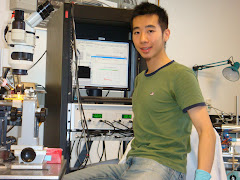
Today, my first publication on soft robots appears in the journal "Bioinspiration and Biomimetics". It is indeed very difficult to publish both in biology and robotics at the same time. Please check out the supplemental videos going along with my paper first. For more stories about the development of my other robots, feel free to browse some older posts.
Almost 5 years ago, I finished my B.A. in a hurry to plunge myself into the research of animal locomotion. As I accepted Tufts' Ph.D student position, I knew that I was caught in a wave of modern robotics innovation. Five years ago, "soft robotics" is a funny term. Even today, roboticists still debate what soft robots really are. In any case, "soft robotics" has transformed from a crazy talk to becoming an active field of research in the past few years. You will hear a lot more about soft robotics this year from me and from many other research teams around the world.
What really triggered this movement is not really clear. But I would venture to say that the DARPA ChemBot project certainly motivated and cultivated the first generation of soft roboticists in the United States. Many Ph.D students PostDocs alike were supported by this program to pursue soft robotics in many aspects. I was one of them.
Although I have received my Ph.D at Tufts and am now working as a postdoc at Harvard, I will continue to blog about caterpillars and soft robots as long as I am still publishing my thesis work throughout the summer. Beyond that point I will probably have to decide where to begin telling a new series of stories about my new pursuit in animal flight.
It's just the beginning!
Tuesday, April 26, 2011


Sunday, March 27, 2011
Caterpillar acoustics
I have been trying to write a new post with real scientific materials in the past two weeks. Frankly, it was very difficult to decide where to start after such a long break. In any case, I finally decided to start with a literature review about acoustics in caterpillars.
Yes, some caterpillars do make sounds and use acoustics for communications. Sounds are essentially mechanical vibrations transmitted via some medium. Any organism capable of creating vibration has the potential to transmit information acoustically. In recent years, acoustic communication has become one of the hot topics among the caterpillar biologists. We know that soft tissues are extremely good at absorbing vibrations. How do caterpillars make a sound with such soft bodies?
Well, there are a number of rigid parts in caterpillars where significant vibration can be generated. For example, the mandibles (the mouthparts) are made of tanned cuticle (chitin composite). They can be as hard as some aluminum or carbon-fiber reinforced polymers (Vincent 2004). To signal territory, cherry leaf roller caterpillars (Caloptilia serotinella) scrap their mandibles across the leaf surface to create vibrations on the leaf. Sometimes, plucking the leaf would be sufficient to generate the vibration. These behaviors are observed more frequently when a conspecific (another caterpillar) stumbles onto the leaf roll (Fletcher et al 2006). Some direct body vibration was observed in these caterpillars but with much rare occurrence. Most acoustic signals are still generated by working the hard mandibles against the substrate.
Alternatively, caterpillars can drag their rear ends across the leaf to produce vibrations. Yes, “anal scraping ” is the technical term used in the original literature that reports this behavior (Yack et al 2001). As much as it sounds indignant for the caterpillars, the methodology is quite effective. Larvae of the hook-tip moth (Drepana arcuata) develop a pair of modified oar-like setae instead on their anal segments (they do not have terminal prolegs). These stiff “anal oars” are less than half a millimeter and bit into the leaf as the animal drag the anal segment across the leaf surface to produce relatively long and audible noise (Bowen et al 2008). Such adaptation has been observed exclusively in the family Drepanae, and it can be shown that the anal oars are derived morphologies in these small leaf-rollers as a special adaptation (Scott et al 2010).
The acoustics in caterpillars continue to make headlines. In February, the Journal of Experimental Biology features a research article reporting whistling behaviors in caterpillars. Again this is not a metaphoric description but an illustrative one. Caterpillars of the North American walnut sphinx (Amorpha juglandis) can produce sounds by expiring forcefully through the spiracles (caterpillar’s air valves) (Bura et al 2011). When a caterpillar contracts forcefully, the body compression can squeeze air out of the tracheal system. I reported this phenomenon in one of my earlier posts as I put crawling caterpillars under water. In the walnut sphinx, however, the spiracles of the anal segment are elongated to produce wider lips for whistling. The caterpillar produces three types of audible acoustic signals in response to simulated predation and effectively startles an attacking bird.
The diverse morphologies and behaviors of caterpillars continue to amaze biologists in different contexts. For caterpillars that are vocal, they certainly have expanded their abilities to relay signals important for survival.
Caterpillars, make some noise!!
References
Bowen, J. L., Mahony, S. J., Mason, A. C. and Yack, J. E. (2008). Vibration‐mediated Territoriality in the Warty Birch Caterpillar Drepana Bilineata. Physiol. Entomol. 33, 238-250.
Bura, V. L., Rohwer, V. G., Martin, P. R. and Yack, J. E. (2011). Whistling in Caterpillars (Amorpha Juglandis, Bombycoidea): Sound-Producing Mechanism and Function. J. Exp. Biol. 214, 30-37.
Fletcher, L. E., Yack, J. E., Fitzgerald, T. D. and Hoy, R. R. (2006). Vibrational Communication in the Cherry Leaf Roller Caterpillar Caloptilia Serotinella (Gracillarioidea: Gracillariidae). J. Insect Behav. 19, 1-18.
Scott, J. L., Kawahara, A. Y., Skevington, J. H., Yen, S. H., Sami, A., Smith, M. L. and Yack, J. E. (2010). The Evolutionary Origins of Ritualized Acoustic Signals in Caterpillars. Nature Communications 1, 1-9.
Vincent, J. F. V. and Wegst,U.G.K. (2004). Design and Mechanical Properties of Insect Cuticle. Arthropod Struct.Dev. 33, 187-199.
Yack, J. E., Smith, M. L. and Weatherhead, P. J. (2001). Caterpillar Talk: Acoustically Mediated Territoriality in Larval Lepidoptera. Proc. Natl. Acad. Sci. U. S. A. 98, 11371.
Thursday, February 17, 2011
Huai-Ti's Ph.D and beyond
Dear friends,
I apologize for the lack of update for such a long time. In the past 5 months, I've been busy with publications, thesis and postdoc interviews. I have successfully defended my thesis on January 26th and am now starting my first postdoctoral research at Harvard University. Many colleagues inquire whether I would keep on blogging. The answer is yes, as this is my major contribution in science outreach. However, given the among of sleep I've been missing and the number of duties I have, I could probably only update once a month.
In the world of scientific research, the researchers are "the projects". There is no way to separate "work" from what people call "life" because research is part of a scientist's life. In fact, it is what makes a scientist "a scientist".
Sincerely
HTL
I apologize for the lack of update for such a long time. In the past 5 months, I've been busy with publications, thesis and postdoc interviews. I have successfully defended my thesis on January 26th and am now starting my first postdoctoral research at Harvard University. Many colleagues inquire whether I would keep on blogging. The answer is yes, as this is my major contribution in science outreach. However, given the among of sleep I've been missing and the number of duties I have, I could probably only update once a month.
In the world of scientific research, the researchers are "the projects". There is no way to separate "work" from what people call "life" because research is part of a scientist's life. In fact, it is what makes a scientist "a scientist".
Sincerely
HTL
Sunday, September 19, 2010
My primary Ph.D projects
It gets pretty confusing about what I do for Ph.D. I am in the Biology Department at Tufts University, getting my Ph.D in biology. However, I've worked with people from biomedical engineering, mechanical engineering, electrical engineering, and computer sciences in the course of my Ph.D training. In fact, most of my colleagues start to think that I'm from "their department" (whatever it is). What exactly am I? That's a very good question which I actually does not have an answer to. Perhaps after I summarize my primary Ph.D research projects below, you may call me whatever you wish with a better understanding of what you are referring to.
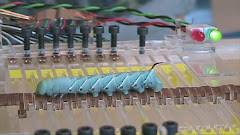
My first project at Tufts was to design a force beam array to collect ground reaction forces from all the leg contacts from Manduca caterpillars in two directions simultaneously. This system involves synchronized video tracking and alternative force transducer design. The results suggested that caterpillars may use the substrate to transmit force much like an external skeleton. I'm currently working on the manuscript for the second part of the animal study.
For soft-bodied animals, tissue material properties can contribute greatly to the overall behaviors. My second project at Trimmer Lab was to instrument a lever-arm system to perform uniaxial tests on soft cuticle from the Manduca caterpillar. These soft specimens were often 5mm long and less than 1mm wide. Real-time video extensometry was necessary to control the strain. We then attempted an constitutive model for the material.
To understand how tissue mechanical properties affect the overall animal behaviors, one must go to the structural level. My third project was to investigate the overall structural properties of the Manduca caterpillar over a scaling range. We tracked down all the body tissue that could take mechanical loads and simulate the hydrostatic skeleton in a FEA model. We found a dramatic increase of flexural stiffness associated with body miniaturization. This implies several evolutionary constraint on caterpillar body plans.
Going beyond the Manduca crawling, I wanted to explore some clues about how caterpillars developed inching gaits in the course of evolution. I first simulated different crawling and inching gaits in my first soft-bodied robot lineage. Then I created a second robot lineage to simulate some ballistic behaviors which were supposed to derive from the normal locomotor patterns. Finally, I conducted a field work in Costa Rica to examine all these caterpillar behaviors in nature across different species.
In summary, my practical skills in the lab allowed me to design systems, acquire all the parts/supplies, manufacture/implement devices, and program systems to execute experiments. I would summarize my scientific contribution in my little niche in three statements.
1) During locomotion, soft-bodied animals can use the substrate as their external skeleton, and therefore gain stability and robustness.
2) The mechanical scaling of hydrostatic skeleton may limit the prolegs configurations and locomotor modes in caterpillars.
3) Soft-bodied robots, by definition, cannot rely on exact postural control. The very minute such a robot force a conformation, it becomes rigid.
My first project at Tufts was to design a force beam array to collect ground reaction forces from all the leg contacts from Manduca caterpillars in two directions simultaneously. This system involves synchronized video tracking and alternative force transducer design. The results suggested that caterpillars may use the substrate to transmit force much like an external skeleton. I'm currently working on the manuscript for the second part of the animal study.
For soft-bodied animals, tissue material properties can contribute greatly to the overall behaviors. My second project at Trimmer Lab was to instrument a lever-arm system to perform uniaxial tests on soft cuticle from the Manduca caterpillar. These soft specimens were often 5mm long and less than 1mm wide. Real-time video extensometry was necessary to control the strain. We then attempted an constitutive model for the material.
To understand how tissue mechanical properties affect the overall animal behaviors, one must go to the structural level. My third project was to investigate the overall structural properties of the Manduca caterpillar over a scaling range. We tracked down all the body tissue that could take mechanical loads and simulate the hydrostatic skeleton in a FEA model. We found a dramatic increase of flexural stiffness associated with body miniaturization. This implies several evolutionary constraint on caterpillar body plans.
Going beyond the Manduca crawling, I wanted to explore some clues about how caterpillars developed inching gaits in the course of evolution. I first simulated different crawling and inching gaits in my first soft-bodied robot lineage. Then I created a second robot lineage to simulate some ballistic behaviors which were supposed to derive from the normal locomotor patterns. Finally, I conducted a field work in Costa Rica to examine all these caterpillar behaviors in nature across different species.
In summary, my practical skills in the lab allowed me to design systems, acquire all the parts/supplies, manufacture/implement devices, and program systems to execute experiments. I would summarize my scientific contribution in my little niche in three statements.
1) During locomotion, soft-bodied animals can use the substrate as their external skeleton, and therefore gain stability and robustness.
2) The mechanical scaling of hydrostatic skeleton may limit the prolegs configurations and locomotor modes in caterpillars.
3) Soft-bodied robots, by definition, cannot rely on exact postural control. The very minute such a robot force a conformation, it becomes rigid.
Wednesday, September 15, 2010
Mechanics of a ballistic roll - Part 2
GoQBot is a soft-bodied robot designed to simulate the ballistic rolling escape behavior in caterpillars. The robot mimics the scale, timing and morphing of the behavior while allowing us to explore the control parameters and perform dynamics tracking. Please refer to earlier posts for more background information.
 Kinematics tracking can be very tricky especially with high speed erratic movements. In order to compute the angular momentum of GoQBot, we must know the mass distribution of the robot as it deforms quickly within the 0.2 second window. One way to do it is to break down the body into many segments and track each segment individually. However, that requires installing more than twenty 1-mm size IR emitters on a small soft body no longer than 12cm. The soldering would be simply a torture, not to mention the wiring. Luckily, there is an alternative: kinematics-based model extrapolation.
 The idea is to constrain a virtual model of the GoQBot using the five IR-marked coordinates as the reference. By applying some deformation characteristics on the model, I can easily extrapolate the positions of every bit of the robot. This is exactly what I have done.
 Kinematics tracking can be very tricky especially with high speed erratic movements. In order to compute the angular momentum of GoQBot, we must know the mass distribution of the robot as it deforms quickly within the 0.2 second window. One way to do it is to break down the body into many segments and track each segment individually. However, that requires installing more than twenty 1-mm size IR emitters on a small soft body no longer than 12cm. The soldering would be simply a torture, not to mention the wiring. Luckily, there is an alternative: kinematics-based model extrapolation.
 The idea is to constrain a virtual model of the GoQBot using the five IR-marked coordinates as the reference. By applying some deformation characteristics on the model, I can easily extrapolate the positions of every bit of the robot. This is exactly what I have done.
Monday, September 6, 2010
Sharing research tools and links
Hi there,
A new section has been added to my blog called "Huai-Ti's research tools". There you would find some useful links from general referencing to good online stores. There are also some good deals such as a free SEM imaging program (but the image will be public). In addition, you may find some useful software for making presentations or publications. For example, there is a Screen Capture Software that streamlines the print-screen function in most computers. Anyways, stuffs like this could be useful when you need it. I will populate this list gradually.
Over the past four years of my R&D, I have designed over 12 instruments, written more than 5 systems of feedback control programs, placed more than 85 orders for supplies and parts. I guess the number of projects and pet projects in experimental science directly correlates to the spending and instrumentation. Also, people in my research team tend to leave purchasing jobs to me since I've been really good at communicating with vendors and company associates to get the right parts for laboratory research. But I have to say such job is really stressful, although all the spending came from various research grants and not from my pocket.
A new section has been added to my blog called "Huai-Ti's research tools". There you would find some useful links from general referencing to good online stores. There are also some good deals such as a free SEM imaging program (but the image will be public). In addition, you may find some useful software for making presentations or publications. For example, there is a Screen Capture Software that streamlines the print-screen function in most computers. Anyways, stuffs like this could be useful when you need it. I will populate this list gradually.
Over the past four years of my R&D, I have designed over 12 instruments, written more than 5 systems of feedback control programs, placed more than 85 orders for supplies and parts. I guess the number of projects and pet projects in experimental science directly correlates to the spending and instrumentation. Also, people in my research team tend to leave purchasing jobs to me since I've been really good at communicating with vendors and company associates to get the right parts for laboratory research. But I have to say such job is really stressful, although all the spending came from various research grants and not from my pocket.
Friday, September 3, 2010
Mechanics of a ballistic roll - Part 1
 First off... I would like to remind you of the behavior that I'm studying. See the ballistic rolls and flips in some leaf roller caterpillars, and check out my biomimetic GoQBot's performance.
To study the the dynamics of such impressive behavior, the robot has been a great tool to test hypotheses and facilitated the collection of mechanical and control data. Back in April this year, I successfully collected the kinematics of GoQBot using my own adaptation of the VICON motion capture system. However, the kinematics data alone only tells half of the story. We could compute the angular momentum as well as the linear momentum from pure motion tracking. However, there is no data on the mechanical power output and loading condition. To extend the analysis, I took one of the force beams I used for caterpillar ground reaction forces measurement and implemented it for robot GRF collection. In fact, VICON system has built-in capabilities to take in force-plate measurements and any other analog signals.
 With some modification and instrumentation, I obtained GRF in two directions from the head anchor and simultaneous recording of the actuator current draw during the high speed kinematics recording. Here are some very preliminary data.
 I'm currently processing the data to calculate the center of mass and the development of angular momentum. More results are coming!!
Wednesday, August 18, 2010
Stop crawling... pace up!!
My Ph.D defense is coming up in December. I better hurry and pace up. When I was 7, I thought about a great deal of things about academic research and becoming a Ph.D. But I always thought of them in future tense. Time is truly incredible.
In any case, I just sent out another manuscript to Journal of Experimental Biology about my studies on the hydrostatic skeleton on caterpillars... three chapters of my thesis done... now onto the fourth one: soft-bodied robots.
Well, thesis writing requires a lot of integration and I've been organizing all my research files in my multiple hard drives as well as lab notes on paper. It's a very tedious yet enlightening process. I realize that my blog updates have been slowing down and infrequent. Well, that's because I begin to invest most of my writing power on my publications and thesis. Sometimes, after going through so much organization, I am left with no energy and patience to write anymore.
Nevertheless, hosting a blog is a commitment. I will post some update on my kinematics-dynamics simultaneous recording of ballistic rolling caterpillar robots in a week. In the mean time, I just release the Costa Rica Fieldwork Journal Part 3, which has been in my draft box for months. Sorry about that!! I will do better...
In any case, I just sent out another manuscript to Journal of Experimental Biology about my studies on the hydrostatic skeleton on caterpillars... three chapters of my thesis done... now onto the fourth one: soft-bodied robots.
Well, thesis writing requires a lot of integration and I've been organizing all my research files in my multiple hard drives as well as lab notes on paper. It's a very tedious yet enlightening process. I realize that my blog updates have been slowing down and infrequent. Well, that's because I begin to invest most of my writing power on my publications and thesis. Sometimes, after going through so much organization, I am left with no energy and patience to write anymore.
Nevertheless, hosting a blog is a commitment. I will post some update on my kinematics-dynamics simultaneous recording of ballistic rolling caterpillar robots in a week. In the mean time, I just release the Costa Rica Fieldwork Journal Part 3, which has been in my draft box for months. Sorry about that!! I will do better...
Monday, July 26, 2010
Quick clarification for the media
I got some inquiries regarding the recent press release on caterpillar gut movement. It is entirely my colleagues' X-ray work and I have not taken any part in that project. Thus I am not responsible for any claims in the NPR interview or other press manuscript. Many online media translations started to deviate from the original release and the announcement does not have any bearing on the on-going or past soft robotic projects.
If you really want to see something in the news, the Boston Globe has a more conservative release, and the NSF promotional video was roughly accurate. As a scientist, I am always concerned about interviews from the mass media because the public can always see sciences in some funny ways. Want the real story? Go straight to the researcher(s) who work(s) on the specific project that interests you. You might be surprised!
If you really want to see something in the news, the Boston Globe has a more conservative release, and the NSF promotional video was roughly accurate. As a scientist, I am always concerned about interviews from the mass media because the public can always see sciences in some funny ways. Want the real story? Go straight to the researcher(s) who work(s) on the specific project that interests you. You might be surprised!
Saturday, July 24, 2010
A short review of my European resonances
I've been away for three weeks in Europe for the Society for Experimental Biology annual meeting and several academic visits . I met quite a few cool people on the road and in meetings. Here I would only highlight a few topics that I found relevant to my current research theme.
At the SEB conference, there were a significant number of people involved with the EU project "Locomorph". I found this new term intriguing. It has been widely recognized that morphology plays a key role in locomotion, and many studies have focused on how the default body configuration function and coordinate to produce desirable kinematics. Well, this project combines "locomotion" and "morphing" into a word so to emphasize the effects of "changing" body morphologies during locomotion. For soft-bodied animals, morphing can be a means to locomotion, but that is the extreme case I'm currently concerned with. For most skeletal systems, coping with a changing morphology is a process of adaptation, and it is this very strategy that biologists and roboticists are interested in. To find out more about this huge collaborative project, see the project website. It sounds awful lot like a DARPA project in the US. I wish good health and good progress to all the people who are involved.
My visit to the EPFL in Switzerland was quite an experience. I heard so many things about it even since I started following robotics stuffs. That's when I was still a teenager. It's quite amazing that I actually get to visit and actually gave a talk about my work. Again, I won't even attempt to summarize people's research, in case I don't do a good job. But one recurring concept in many robotic efforts was localized intelligence and the emergent properties. Indeed, intelligence does not have to live in a central processing unit. Localized simple logic goes a long way when certain information sharing occur between the functional nodes. This can be seen at the sensory reflex level such as the optical flow control drones, or on the coordination level as in the salamander robot's coupled oscillators, or at the navigation level where swarms of MAVs create a communication network. In a way, I think this is how intelligence arise in any systems. Even our complex brain employ millions of neurons to generate a gross computation. Each single neuron has its own logic depending on the excitability and pre-conditioning. To exchange information, neurons rely on the varied synapses which can be modulated dynamically as well. In fact, I would go so far to say that all forms of intelligence are emergent properties of certain collection of simple logic units. This subject is indeed fascinating and I think using robots is often a more efficient way to study it. Browse their website to find out more.
U. Jena Lauflabor is known for the development of the SLIP (Spring Loaded Inverted Pendulum) model for biped locomotion. More specifically, this group of physicists attempt to find dynamic stability in a open-loop control scenario. In contrast to the reflex model for locomotion as employed in many traditional robots, researchers at Jena really investigate how inherent walk-run mechanics and leg properties can produce stability. Implementing robots from these simulations may lead to much more elegant solutions to legged locomotion, far from the reflex control as demonstrated by Boston Dynamics' "Big Dog" (which is very impressive, but not very smart). Their goal is actually similar to my soft-bodied robotic trials, except that our subjects are really quite distinct.
In any case, these are only three things that seem the most relevant to my current research goals. The field of biomechanics is really growing bigger each year and the use of robots has become a standard procedure now (for one purpose or the other).
At the SEB conference, there were a significant number of people involved with the EU project "Locomorph". I found this new term intriguing. It has been widely recognized that morphology plays a key role in locomotion, and many studies have focused on how the default body configuration function and coordinate to produce desirable kinematics. Well, this project combines "locomotion" and "morphing" into a word so to emphasize the effects of "changing" body morphologies during locomotion. For soft-bodied animals, morphing can be a means to locomotion, but that is the extreme case I'm currently concerned with. For most skeletal systems, coping with a changing morphology is a process of adaptation, and it is this very strategy that biologists and roboticists are interested in. To find out more about this huge collaborative project, see the project website. It sounds awful lot like a DARPA project in the US. I wish good health and good progress to all the people who are involved.
My visit to the EPFL in Switzerland was quite an experience. I heard so many things about it even since I started following robotics stuffs. That's when I was still a teenager. It's quite amazing that I actually get to visit and actually gave a talk about my work. Again, I won't even attempt to summarize people's research, in case I don't do a good job. But one recurring concept in many robotic efforts was localized intelligence and the emergent properties. Indeed, intelligence does not have to live in a central processing unit. Localized simple logic goes a long way when certain information sharing occur between the functional nodes. This can be seen at the sensory reflex level such as the optical flow control drones, or on the coordination level as in the salamander robot's coupled oscillators, or at the navigation level where swarms of MAVs create a communication network. In a way, I think this is how intelligence arise in any systems. Even our complex brain employ millions of neurons to generate a gross computation. Each single neuron has its own logic depending on the excitability and pre-conditioning. To exchange information, neurons rely on the varied synapses which can be modulated dynamically as well. In fact, I would go so far to say that all forms of intelligence are emergent properties of certain collection of simple logic units. This subject is indeed fascinating and I think using robots is often a more efficient way to study it. Browse their website to find out more.
U. Jena Lauflabor is known for the development of the SLIP (Spring Loaded Inverted Pendulum) model for biped locomotion. More specifically, this group of physicists attempt to find dynamic stability in a open-loop control scenario. In contrast to the reflex model for locomotion as employed in many traditional robots, researchers at Jena really investigate how inherent walk-run mechanics and leg properties can produce stability. Implementing robots from these simulations may lead to much more elegant solutions to legged locomotion, far from the reflex control as demonstrated by Boston Dynamics' "Big Dog" (which is very impressive, but not very smart). Their goal is actually similar to my soft-bodied robotic trials, except that our subjects are really quite distinct.
In any case, these are only three things that seem the most relevant to my current research goals. The field of biomechanics is really growing bigger each year and the use of robots has become a standard procedure now (for one purpose or the other).
Wednesday, July 14, 2010
The European Tour
Sorry everybody!!
I've been traveling across Europe for more than two weeks already. The internet access and schedule doesn't really allow me to do any serious blogging. However, I will be reviewing some of the things I learned from all the amazing biomechanics researchers in Europe next week when I go back to Boston. Stay tuned!!
Huai-Ti (YT)
I've been traveling across Europe for more than two weeks already. The internet access and schedule doesn't really allow me to do any serious blogging. However, I will be reviewing some of the things I learned from all the amazing biomechanics researchers in Europe next week when I go back to Boston. Stay tuned!!
Huai-Ti (YT)
Saturday, June 12, 2010
Field Work Journal (Part 3)
6/7
Working in reverse, I started to examine how inching caterpillars may revert to crawling gait. Behaviorally it's quite feasible and we've observed some tiny step crawling when inchworms adjust their bodies on the foliage. My discovery of the day was that by constraining the uplifting body bend, I can actually induce crawling in many caterpillars that inch as their default gait. What I did was a very simple behavioral experiment: take a sheet of heavy duty plastic bag and lay it on top of a inching caterpillar on a flat surface. The result was quite stunning: the weight of the plastic prevent body upward bulking, so the inchworms start the stereotypical anterior-grade crawling. The very second plastic sheet constraint is gone (when I remove the plastic sheet or when they simply crawl out from under the sheet) they start inching again. This transition can happen at any phase of a gait cycle and so reversible that I can't imaging any other gait transition mechanism other than a biomechanical one. The implication is quite mind-bogging: inching gaits came naturally when mid-abdominal segments are not locked down to the substrate. 6/8
6/8
I went back to the memorial behind the casona today for the sunset. Actually I went with my friend Ian. The casona is a big historic farm house that has been converted to a little museum to document the development of ACG. The memorial was built for many worriers and political leaders who defended Costa Rica against an ambitious Nicaragua war-lord in 80's. This memorial is about two stories high at the top of a hill, overlooking the entire Santa Rosa sector and the two main volcanoes on the other side of the intercontinental highway. We walked up there briskly right after dinner and caught glimpse of sunset. Before it became pitch-dark, I looked around and wonder where the scorpion I met earlier went, and whether it also lingered around at sunset.
 6/9
6/9
My Costa Rica stay is drawing to an end, but I feel that everything has just become part of my life... three meals of rice and beans everyday, new trails everywhere, mosquito swarms at certain spots, incomprehensible language that sounds very familiar, WiFi domain guided by the trees, checking e-mail late at night in pitch-dark with some frogs as companies. The list goes on and on, making my experience quite unforgettable.
 Today I decided to stop looking for caterpillars, otherwise I can't really wrap up the study. I went back to the caterpillar barn to examine all the caterpillars I've been working with and start to let them lose. If there is a video that is so amusing and that I can release freely, it is this video that I captured today of two noctuidae inching along a jar cover. Why is it funny? Well, I love the way they negotiate with each other. This circular walk lasted for about 6min until I got tired of filming. Apparently, you don't need very fancy enclosure to keep inching caterpillars. They would happily stay on a nice upright track even if it has a periodic boundary -- never ending. Isn't that what we call "inertia"?
Working in reverse, I started to examine how inching caterpillars may revert to crawling gait. Behaviorally it's quite feasible and we've observed some tiny step crawling when inchworms adjust their bodies on the foliage. My discovery of the day was that by constraining the uplifting body bend, I can actually induce crawling in many caterpillars that inch as their default gait. What I did was a very simple behavioral experiment: take a sheet of heavy duty plastic bag and lay it on top of a inching caterpillar on a flat surface. The result was quite stunning: the weight of the plastic prevent body upward bulking, so the inchworms start the stereotypical anterior-grade crawling. The very second plastic sheet constraint is gone (when I remove the plastic sheet or when they simply crawl out from under the sheet) they start inching again. This transition can happen at any phase of a gait cycle and so reversible that I can't imaging any other gait transition mechanism other than a biomechanical one. The implication is quite mind-bogging: inching gaits came naturally when mid-abdominal segments are not locked down to the substrate.
 6/8
6/8I went back to the memorial behind the casona today for the sunset. Actually I went with my friend Ian. The casona is a big historic farm house that has been converted to a little museum to document the development of ACG. The memorial was built for many worriers and political leaders who defended Costa Rica against an ambitious Nicaragua war-lord in 80's. This memorial is about two stories high at the top of a hill, overlooking the entire Santa Rosa sector and the two main volcanoes on the other side of the intercontinental highway. We walked up there briskly right after dinner and caught glimpse of sunset. Before it became pitch-dark, I looked around and wonder where the scorpion I met earlier went, and whether it also lingered around at sunset.
 6/9
6/9My Costa Rica stay is drawing to an end, but I feel that everything has just become part of my life... three meals of rice and beans everyday, new trails everywhere, mosquito swarms at certain spots, incomprehensible language that sounds very familiar, WiFi domain guided by the trees, checking e-mail late at night in pitch-dark with some frogs as companies. The list goes on and on, making my experience quite unforgettable.
 Today I decided to stop looking for caterpillars, otherwise I can't really wrap up the study. I went back to the caterpillar barn to examine all the caterpillars I've been working with and start to let them lose. If there is a video that is so amusing and that I can release freely, it is this video that I captured today of two noctuidae inching along a jar cover. Why is it funny? Well, I love the way they negotiate with each other. This circular walk lasted for about 6min until I got tired of filming. Apparently, you don't need very fancy enclosure to keep inching caterpillars. They would happily stay on a nice upright track even if it has a periodic boundary -- never ending. Isn't that what we call "inertia"?
Field Work Journal (Part 2)
6/4
I started another day with fried rice and beans plus scramble eggs and cheese. Just when I got to my second coffee around 7:30am the bus brought in all the park rangers in for breakfast. People streamed into the Comidor with greetings and jokes. I watched them eat and talk and set out to work with a mouthful of Costa Rican rice coffee aroma. Somewhere in my heart, I envied such life: so simple, so natural and communal.
 It’s time to organize data and find out what and what else can I get out of this trip. I started up with three aspects: Biometry, Kinematics, and Behavior. The biometry project was targeted to compare the biometry proportions of different caterpillar species as well as tracking down the ontogenetic scaling of some species. The only way to perform measurements on soft-bodied animal is to use photography. Unfortunately, caterpillars are wild animals after all. There is no easy way to get them to sit still in a specific posture while I photograph. Weighing them is also impractical because many of them do not relinquish their substrate (often their food as well). Brute force can injure caterpillars and decrease their survival rate dramatically, making ontogenetic tracking impossible. However, the general biometry can be still obtained from the video frames I collect in the kinematics project. One of the measurements I was looking for is the aspect ratio of the cylindrical body. Compare the two caterpillars before and after this paragraph to see what I mean.

6/5
In a forest full of activities, it is very difficult to stay put for more than a day. Although I haven’t finished the image organization on my two EEE PCs, I decide to head out to the field anyways. As the sun journeyed pass 10am, the wet “dry forest” turned into a steamer. I could smell many things around me, from fresh leaves to fermentation in the rotten woods. The strongest of all was a pungent smell that reminded me of steamed peanuts. I never figured out what that was, but it definitely imprinted in my memory of Santa Rosa. Anyways, the most memorable discovery from today’s field work was a leaf craftily “eaten” into a beautiful symmetric pattern. I couldn’t help but respect the "minds" of these wild caterpillars.

Over time, I found myself very tuned in to looking for caterpillars. I could distinguish leaves damaged by caterpillars from those eaten by ants or beetles. I was able to spot the caterpillar feces and trace the source to a plant, and I became pretty picky about what caterpillar I get. One of the tasks for today’s field work was to collect some cydista plants for my Manduca lanuginose. This was the only Manduca I found so far so I really should keep them alive. Just as I was full with plastic bags of caterpillar and plant harvest, something lighted up my eyes. It was a huge Manduca sexta gorging up a Solanum hayesii. I was very excited to see such a familiar body even though my memory of Manduca has been this obstinate stupid animal in the lab. For some reason, the wild type looked much brighter in color. It’s got a puffy body with clear healthy white lateral strips. Maybe the organic food really made a difference.
6/6
The English speaking researchers tend to cluster in one table at dinner, although many of them speak perfect Spanish. I have been meaning to learn to speak a few words, but the data organization work every night really crushed my ambition. Over some rice and beans with pork stomach, we talked about what we encountered during the day and frustration with the animals. Indeed, field work is a very different mode of research. We are studying the organisms in the great nature which is beyond our power to control. We cannot force any activities or interactions. We must let them come to us. Patience is the key and letting things be is the attitude.
Due to my field work during the day, I started to shift my caterpillar photography work to after dinner. Tonight, I found a keystone to solving the gait transition mystery in caterpillars. So far I’ve found caterpillars that inch with reduced prolegs and caterpillar that crawl with full prolegs. This caterpillar I picked up today inches with full prolegs, displaying how exactly a inching gait can be derived from a crawling pattern. This spotted caterpillar had a full set of functional prolegs from abdominent 3rd. However, when it picked up speed to run away from me, it lifted very large proportion of its body and actually cut under itself to gain the maximum step length. The whole gait pattern resembled a very conservative inching which can be shifted into a crawl at any moment in a cycle.

I started another day with fried rice and beans plus scramble eggs and cheese. Just when I got to my second coffee around 7:30am the bus brought in all the park rangers in for breakfast. People streamed into the Comidor with greetings and jokes. I watched them eat and talk and set out to work with a mouthful of Costa Rican rice coffee aroma. Somewhere in my heart, I envied such life: so simple, so natural and communal.
 It’s time to organize data and find out what and what else can I get out of this trip. I started up with three aspects: Biometry, Kinematics, and Behavior. The biometry project was targeted to compare the biometry proportions of different caterpillar species as well as tracking down the ontogenetic scaling of some species. The only way to perform measurements on soft-bodied animal is to use photography. Unfortunately, caterpillars are wild animals after all. There is no easy way to get them to sit still in a specific posture while I photograph. Weighing them is also impractical because many of them do not relinquish their substrate (often their food as well). Brute force can injure caterpillars and decrease their survival rate dramatically, making ontogenetic tracking impossible. However, the general biometry can be still obtained from the video frames I collect in the kinematics project. One of the measurements I was looking for is the aspect ratio of the cylindrical body. Compare the two caterpillars before and after this paragraph to see what I mean.
6/5
In a forest full of activities, it is very difficult to stay put for more than a day. Although I haven’t finished the image organization on my two EEE PCs, I decide to head out to the field anyways. As the sun journeyed pass 10am, the wet “dry forest” turned into a steamer. I could smell many things around me, from fresh leaves to fermentation in the rotten woods. The strongest of all was a pungent smell that reminded me of steamed peanuts. I never figured out what that was, but it definitely imprinted in my memory of Santa Rosa. Anyways, the most memorable discovery from today’s field work was a leaf craftily “eaten” into a beautiful symmetric pattern. I couldn’t help but respect the "minds" of these wild caterpillars.

Over time, I found myself very tuned in to looking for caterpillars. I could distinguish leaves damaged by caterpillars from those eaten by ants or beetles. I was able to spot the caterpillar feces and trace the source to a plant, and I became pretty picky about what caterpillar I get. One of the tasks for today’s field work was to collect some cydista plants for my Manduca lanuginose. This was the only Manduca I found so far so I really should keep them alive. Just as I was full with plastic bags of caterpillar and plant harvest, something lighted up my eyes. It was a huge Manduca sexta gorging up a Solanum hayesii. I was very excited to see such a familiar body even though my memory of Manduca has been this obstinate stupid animal in the lab. For some reason, the wild type looked much brighter in color. It’s got a puffy body with clear healthy white lateral strips. Maybe the organic food really made a difference.
6/6
The English speaking researchers tend to cluster in one table at dinner, although many of them speak perfect Spanish. I have been meaning to learn to speak a few words, but the data organization work every night really crushed my ambition. Over some rice and beans with pork stomach, we talked about what we encountered during the day and frustration with the animals. Indeed, field work is a very different mode of research. We are studying the organisms in the great nature which is beyond our power to control. We cannot force any activities or interactions. We must let them come to us. Patience is the key and letting things be is the attitude.
Due to my field work during the day, I started to shift my caterpillar photography work to after dinner. Tonight, I found a keystone to solving the gait transition mystery in caterpillars. So far I’ve found caterpillars that inch with reduced prolegs and caterpillar that crawl with full prolegs. This caterpillar I picked up today inches with full prolegs, displaying how exactly a inching gait can be derived from a crawling pattern. This spotted caterpillar had a full set of functional prolegs from abdominent 3rd. However, when it picked up speed to run away from me, it lifted very large proportion of its body and actually cut under itself to gain the maximum step length. The whole gait pattern resembled a very conservative inching which can be shifted into a crawl at any moment in a cycle.

Thursday, June 3, 2010
Field Work Journal (Part 1)
Part 1 --- 6/1~3
6/1
I was so busy figuring out experimental protocols and data analysis during the first week of my stay. Every night I barely had energy to brush my teeth, not to mentioned writing in my journal book. My advisor left yesterday so I’m literally on my own now. But I think I am in good hands. The dormitory house keeper Lily helped me with my laundry on Sunday even though I didn’t have any soap. When I came back in 40min, she was already folding my clean dried clothes in the laundry room. The cook Aida came up with some food for me tonight when I worked overtime and forgot about the dinner time. Somehow I think they could empathize this poor young Asian kid who doesn’t even know how to say “por favor”. Of course, Dan and Winnie continued to bring me interesting caterpillars when they encounter them. What more could I wish for in the care of these people.
 All the inching caterpillars I worked with so far tend to be very active. Some of them moved with impressive speed (up to ~4cm/s). In addition, they can also perform various acrobatic moves especially in the situation of disturbance. This Anomis I picked up today demonstrated one of the most memorable moves in front of my camera. It simply “disappeared” when I poked it on the rear back. 300fps high speed video showed exactly what it did. The caterpillar first span some silk around the thoracic legs, then it flip its whole body sideway with extremely high speed. The prolegs release was nicely coordinated to let go of the momentum it built up. The result was a ballistic lateral jump. The caterpillar landed on another leaf below the substrate I provided. It then used the silk line to climb back to the exact same spot where it jumped off. I simply couldn’t say a word but marvel such innate skill.
6/2
I took today off for a hike with my new friends, mainly to explore the conservation area and also to get some exercises. The focus of field collection was never about walking, and I found myself so out of shape. Nevertheless, I carried my big CASIO EXLIM camera in case my SONY Cybershot can’t do some animals justice. Field exploration is very much part of the field work. You never know what you would find by wondering about without a particular search criterion in mind. We started out right after breakfast at 7:30am and headed straight down to the valley. It was a pretty damaging road for most cars, but an easy one for hikers.
 I met more butterflies than caterpillars on my way down to the coast line. They all cluster under the sun sucking liquid on the mud or some rocks. Wing flaps by wing flaps just like having group meetings. The blazing sun started to steam up the water from yesterday’s rain. Each water puddle contained thousands of tadpoles and supported tens of water surface insects. I found another beetle larva moving upside down by peristaltic on the rocky ground. I wonder why they still keep their thoracic legs if they don’t even use it for locomotion. At the bottom of the valley we crossed two rivers. We met a gang of monkeys after we waded across the second one. My friend was somewhat aggressive on photo shooting, that the monkeys decided to protest. Several of them started breaking branches to drop on top of us, and many more gather over. We left soon after these demonstrations. Sometimes, communication can be so effective. We were caught in the pouring rain when we reached the beach. It didn’t bother us much since we were all soaking wet in sweat anyways. Sweat, rain, and Pacific Ocean all mixed together as we headed back to the research station.
6/3
Today I had to move out of my room to stay with other researchers. It was a bit of a hassle, but I don't mind joining the party. Having a room with four double bunkers for myself is too luxurious out in the forest. It was always an adventure to interact with the ACG staffs, because I pretty much don't speak Spanish and many of them don't speak English. In any case, we all managed to came to the same conclusion on our subject whatever it was. Still, I wish I spoke Spanish. I’m missing so much.
 My caterpillars in the barn are doing pretty well now. But I need to finish up filming these caterpillars before I can get more. I can never predict when I will lose them to stress, parasite, or pupation. The inchworm Sphacelodes I picked up before breakfast was the largest geo I’ve even seen. It’s about 3.5 cm long and weighed 0.146g. However, it had every bit of athleticism of Geometridae. Most geo’s preferred to inch on top of the branches if possible, but this one had much stronger preference. When I turned it upside down on my dowel, it started to have trouble pulling the body in. After a few steps it just spiraled around to the top of the dowel again. Well, counter-levering a hydrostatic body up to 3.5cm long does become pretty difficult with only ~0.5cm leverage.
6/1
I was so busy figuring out experimental protocols and data analysis during the first week of my stay. Every night I barely had energy to brush my teeth, not to mentioned writing in my journal book. My advisor left yesterday so I’m literally on my own now. But I think I am in good hands. The dormitory house keeper Lily helped me with my laundry on Sunday even though I didn’t have any soap. When I came back in 40min, she was already folding my clean dried clothes in the laundry room. The cook Aida came up with some food for me tonight when I worked overtime and forgot about the dinner time. Somehow I think they could empathize this poor young Asian kid who doesn’t even know how to say “por favor”. Of course, Dan and Winnie continued to bring me interesting caterpillars when they encounter them. What more could I wish for in the care of these people.
 All the inching caterpillars I worked with so far tend to be very active. Some of them moved with impressive speed (up to ~4cm/s). In addition, they can also perform various acrobatic moves especially in the situation of disturbance. This Anomis I picked up today demonstrated one of the most memorable moves in front of my camera. It simply “disappeared” when I poked it on the rear back. 300fps high speed video showed exactly what it did. The caterpillar first span some silk around the thoracic legs, then it flip its whole body sideway with extremely high speed. The prolegs release was nicely coordinated to let go of the momentum it built up. The result was a ballistic lateral jump. The caterpillar landed on another leaf below the substrate I provided. It then used the silk line to climb back to the exact same spot where it jumped off. I simply couldn’t say a word but marvel such innate skill.
6/2
I took today off for a hike with my new friends, mainly to explore the conservation area and also to get some exercises. The focus of field collection was never about walking, and I found myself so out of shape. Nevertheless, I carried my big CASIO EXLIM camera in case my SONY Cybershot can’t do some animals justice. Field exploration is very much part of the field work. You never know what you would find by wondering about without a particular search criterion in mind. We started out right after breakfast at 7:30am and headed straight down to the valley. It was a pretty damaging road for most cars, but an easy one for hikers.
 I met more butterflies than caterpillars on my way down to the coast line. They all cluster under the sun sucking liquid on the mud or some rocks. Wing flaps by wing flaps just like having group meetings. The blazing sun started to steam up the water from yesterday’s rain. Each water puddle contained thousands of tadpoles and supported tens of water surface insects. I found another beetle larva moving upside down by peristaltic on the rocky ground. I wonder why they still keep their thoracic legs if they don’t even use it for locomotion. At the bottom of the valley we crossed two rivers. We met a gang of monkeys after we waded across the second one. My friend was somewhat aggressive on photo shooting, that the monkeys decided to protest. Several of them started breaking branches to drop on top of us, and many more gather over. We left soon after these demonstrations. Sometimes, communication can be so effective. We were caught in the pouring rain when we reached the beach. It didn’t bother us much since we were all soaking wet in sweat anyways. Sweat, rain, and Pacific Ocean all mixed together as we headed back to the research station.
6/3
Today I had to move out of my room to stay with other researchers. It was a bit of a hassle, but I don't mind joining the party. Having a room with four double bunkers for myself is too luxurious out in the forest. It was always an adventure to interact with the ACG staffs, because I pretty much don't speak Spanish and many of them don't speak English. In any case, we all managed to came to the same conclusion on our subject whatever it was. Still, I wish I spoke Spanish. I’m missing so much.
 My caterpillars in the barn are doing pretty well now. But I need to finish up filming these caterpillars before I can get more. I can never predict when I will lose them to stress, parasite, or pupation. The inchworm Sphacelodes I picked up before breakfast was the largest geo I’ve even seen. It’s about 3.5 cm long and weighed 0.146g. However, it had every bit of athleticism of Geometridae. Most geo’s preferred to inch on top of the branches if possible, but this one had much stronger preference. When I turned it upside down on my dowel, it started to have trouble pulling the body in. After a few steps it just spiraled around to the top of the dowel again. Well, counter-levering a hydrostatic body up to 3.5cm long does become pretty difficult with only ~0.5cm leverage.
Subscribe to:
Posts (Atom)
.jpg)